

Summer is a beautiful time of year, but the scorching heat can wreak havoc on your turf. If you want to keep your grass lush, resilient, and the envy of the neighborhood, you need a strategy. Welcome to your definitive summer watering guide, brought to you by Lawngevity.
Maintaining a pristine lawn during the hottest months doesn’t have to be a guessing game. By understanding exactly how much, when, and how to water, you can protect your investment and enjoy a vibrant yard all season long. Let us dive into the essential rules for summer lawn care.
Why You Need a Summer Watering Guide
When temperatures soar from June through August, your lawn enters a high-stress period. Evaporation rates skyrocket, and without the right approach, you could end up wasting water while your grass slowly turns brown. A proper summer watering guide helps you balance hydration with conservation, ensuring every drop counts.
The Golden Rule: 1.5 Inches Per Week
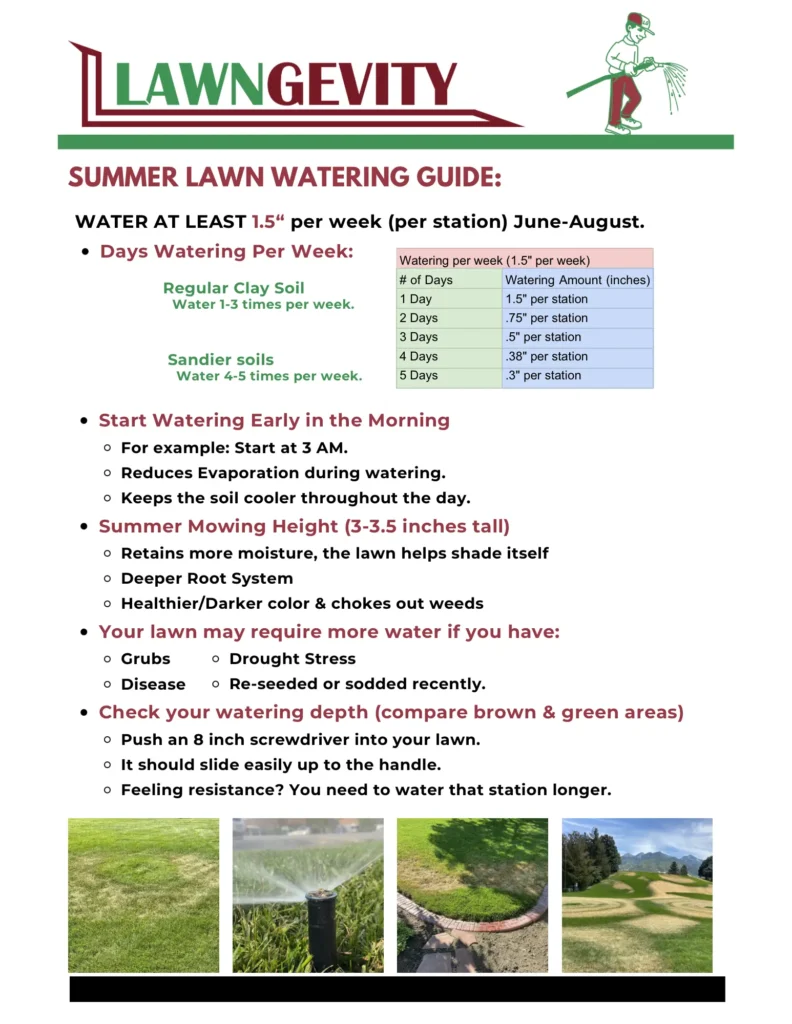
At Lawngevity, our foundational recommendation for summer lawn care is simple: water at least 1.5 inches per week, per station, June through August.
This doesn’t mean giving your lawn a light sprinkle every afternoon. Shallow watering encourages shallow root systems, making your grass highly vulnerable to heat waves. Instead, you want deep, infrequent watering sessions that train the roots to reach deep into the earth for moisture.
Understanding Sprinkler System Efficiency
Not all sprinkler systems are created equal, and performance varies significantly between equipment types. For instance, while some spray heads can deliver 1/2 inch of water in just 15–20 minutes, other systems, particularly those using rotary nozzles, can require up to 90 minutes to achieve the same coverage.
Because of this variability, relying on a one-size-fits-all timer setting can lead to over- or under-watering. To optimize efficiency and conserve water:
- Conduct a ‘Catch Cup Test’: Place flat-bottomed containers (like empty tuna cans) at various points in your lawn during a watering cycle. This allows you to measure exactly how much water your specific sprinklers put out over a set period.
- Adjust Based on Real Data: Once you know how long it takes your system to deliver 1/2 inch of water, adjust your controller run times accordingly rather than guessing.
- Consider Upgrades: If your system is inconsistent or inefficient, consider upgrading to high-efficiency nozzles or heads, which can improve distribution uniformity and help you meet your lawn’s hydration needs without unnecessary waste.
Adapting Your Summer Watering Guide for Your Soil Type
Not all lawns are built on the same foundation. To make the most of your summer watering guide, you have to look beneath the surface. The type of soil you have dictates how fast water absorbs and how long it stays there.
Watering Regular Clay Soil
Clay soil is dense and tightly packed. It holds onto water beautifully, but it absorbs it incredibly slowly.
- The Strategy: If you apply 1.5 inches of water all at once to clay, you’ll end up with massive runoff and puddles. Break your watering time for each station into smaller cycles. For example, water .5 inches three times a week vs doing 1.5 inches all at once.
Watering Sandy Soil
Sandy soil is the exact opposite of clay. It’s loose, porous, and drains incredibly fast. While it absorbs water easily, it can’t hold onto it for very long.
- The Strategy: Because water filters right through sand, you’ll likely need to split that 1.5-inch weekly requirement into more frequent applications. Instead of watering twice a week, you might need to water five times a week to keep the roots consistently hydrated.
Timing and Pro Tips for Your Summer Watering Guide
When you water is just as important as how much you water. If you’re watering in the middle of a hot afternoon, a massive percentage of that water never even reaches the roots—it evaporates straight into the air.
Start Watering Early in the Morning
The absolute best time to turn on your sprinklers is between 3 AM and 6 AM. We highly recommend you start watering early in the morning to reduce evaporation and keep soil cooler during the day.
Watering at 3 AM ensures the wind is typically calm, the air is cool, and the water can soak deeply into the soil. It gives your grass a refreshing reservoir of moisture to draw from right as the heat of the day sets in. Plus, it allows the blades to dry quickly once the sun comes up, preventing fungal diseases that thrive on grass left wet overnight.
The Screwdriver Test: How to Check Your Depth
Are you unsure if your watering sessions are actually doing the trick? You can easily check watering depth by pushing an 8-inch screwdriver into the lawn—it should slide easily up to the handle. If not, water that station longer. If you hit hard, dry resistance just a couple of inches down, it’s a clear sign that your current runtime is not deep enough.
Mow High to Save Water
Your mower settings play a massive role in your irrigation efficiency. Throughout the summer, you should keep grass 3-3.5 inches tall to help retain moisture and help the lawn shade itself. Taller grass encourages a deeper root system and helps choke out weeds. Think of the taller grass blades as a natural blanket that protects the soil from the baking sun.
When to Adjust Your Summer Watering Guide
While 1.5 inches per week is the baseline, nature loves to throw curveballs. A rigid schedule can sometimes fail if your lawn is fighting off underlying stressors.
Here are a few reasons your lawns may require more water if you have grubs, disease, drought stress, or have re-seeded/laid sod recently:
- Pest Damage: Grubs eat away at the root system, destroying the lawn’s ability to take up water. Affected areas will need extra hydration to survive while you treat the pest issue.
- Fungal Disease: A stressed lawn is a weak lawn. If a disease takes hold, careful watering adjustments are necessary to help the turf recover without worsening the fungus.
- New Seed or Sod: Brand new grass has an incredibly shallow root system. It needs constant, light moisture multiple times a day until the roots fully establish themselves in the soil.
By tracking these factors and utilizing this summer watering guide, you can keep your yard healthy and resilient through the worst of the summer heat. If you need help diagnosing a lawn issue or optimizing your irrigation system, the team at Lawngevity is always here to help!